Immersive Previz for The Weeknd's 'Open Hearts': The First Apple Immersive Music Video
Sun 25th January, 2026
Explore how the creative team behind Open Hearts, the first Apple Immersive music video, redefined storyboarding through stereoscopic previsualization.
Previsualising Open Hearts by The Weeknd: The First Apple Immersive Music Video
In the ‘Meet with Apple’ presentation, director Anton Tammi explains previsualization in Unreal Engine as a ‘CGI-animated representation of the finished product that provides space to experiment, test ideas quickly, and refine.’
Previsualization (previs) is the practice of building a CG-driven prototype of a film before production begins. Often this includes developing 3D versions of scenes, allowing directors and teams to plan camera angles, actor movements, lighting, and visual effects.
It functions as an immersive storyboard that allows you to plan complex shots with precision, communicate vision clearly with film crew, so that the production is cost-efficient and streamlined. With Previs, one could ‘see the film before it was made’ – Anton Tammi in Meet with Apple activity “Create immersive media experiences for visionOS.
Using the Off World Live 360-degree virtual camera inside Unreal Engine, filmmakers were able to see the film before it existed directly inside Vision Pro.
How is Immersive Production Different from Traditional Filmmaking?
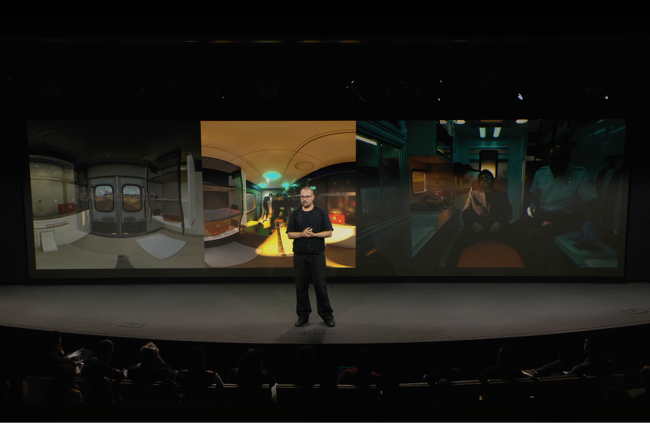
Unlike traditional filmmaking, which primarily revolves around what is ‘in-frame’ or ‘out-of-frame’, immersive film production forces filmmakers to consider everything that is visible in the virtual reality space. This means that within the 180-degree wide framing, there are no traditional cheats in lighting, blocking, or set design that can happen off-camera. This also reveals how previs is necessary for the crew to familiarize themselves with a different method of production. The team behind ‘Open Hearts’ explained how the sharp depth of field and wide framing meant that every detail is sharply resolved, which meant that greater precision is required on the day of shooting.
Finally, beyond rendering for the screen, building for Apple Vision Pro also meant that proximity and motion comfort matters, as you are designing for an experience, ‘how it feels to inhabit the space’, instead of just viewing a flat image.
Step-by-Step Guide to Previs in Unreal Engine
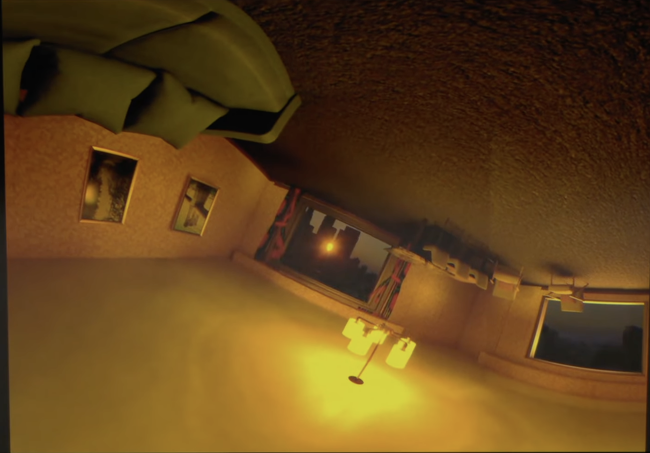
Build custom virtual camera rigs in Unreal Engine: Design camera blueprints that replicate immersive capture constraints.
- Visualize and storyboard performance, motion, and spatial relationships in Unreal Engine: Use custom camera blueprints to access virtual camera in CG space, create collision warnings etc.
- Render stereoscopic immersive previews: Export to match apple immersive camera
- Review in Apple Vision Pro and iterate
Off World Live seamlessly integrates the immersive previs workflow for spatial filmmaking through:
- Live 360° and 180° stereoscopic rendering inside Unreal Engine
- Rapid iteration and feedback
- Blueprint-compatible camera systems, ideal for custom immersive rigs
- Export pipelines aligned with Apple Immersive formats, enabling direct preview in Apple Vision Pro
- Supports alpha output, stencil layers, post process materials, professional color grading, 180/ 360 cross fades, 180/ 360 burn-ins, custom projection settings
Additional considerations for Apple Vision Pro
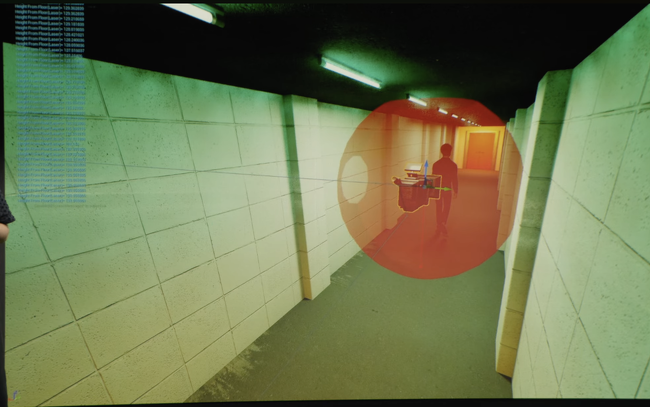
The team has also incorporated a ‘comfort sphere’ around the virtual camera in the process so that they are aware of the comfortable distance viewers have in relation to other objects in the scene.
Spatial Comfort: As characters, vehicles, or set elements moved through the scene, they could instantly see when something entered the collision ball, this would imply that the objects are too close for comfortable viewing in Apple Vision Pro.
Tight spaces were compromised because they would not meet these comfort thresholds. In this case larger environments (ambulances, corridors, open roads) were substituted for better spatial experience.
Motion Comfort: The virtual camera was anchored to visible reference points (e.g. the hood of a vehicle) to maintain viewer stability. The camera blueprint also measured height from ground so that the crew can monitor its viewpoint to make sure there is no discomfort or disorientation introduced in the scene.
The Team behind ‘Open Hearts’ Previs
Anton Tammi, Director
Anton comes from Helsinki, Finland. His nonlinear narratives, breathtaking and experimental approach to editing color and cinematography is completely unique. After cutting his teeth in the editing rooms of Helsinki, he started working internationally and introduced his offbeat style to the music video world.
https://www.instagram.com/antontammi/
Nick Turner, Previs Artist